How many hands until your win rate means anything? With a typical standard deviation of around 80 big blinds per 100 hands for a regular in online no-limit hold'em cash games, most players need somewhere between 300,000 and 1,000,000 hands before their bb/100 settles into a range they can actually trust. Ten thousand hands, the number most players quote after a good month, barely moves the needle.
- 📊 A huge sample is required, even 50,000 hands leaves a wide margin of error around your real bb/100.
- 📉 Downswings are expected, not a signal, a standard deviation near 80bb/100 makes single-session results almost meaningless.
- 🎲 Big edges still lose often, a pair racing against a bigger pair loses about 20% of the time, and that is with the best of it.
- 🔑 Leaks are visible long before your win rate is, a hand-by-hand review finds real errors while your sample is still too small to trust.
That gap between what feels convincing and what is statistically convincing is where most self-assessment goes wrong. A losing week reads like a leak. A hot streak reads like proof a strategy works. Neither one, on its own, is proof of anything, and the maths behind why is not complicated once you see the numbers laid out.
What your win rate actually measures
Win rate in poker is usually expressed in bb/100: the number of big blinds won or lost per 100 hands, averaged across a sample. It exists specifically to normalize results across stakes and table sizes, so a $2 win at $1/$2 and a $20 win at $10/$20 both read as 1bb/100.
The problem is not the metric. The problem is that bb/100 is an average, and an average calculated on a small sample carries a large margin of error. A player showing +15bb/100 over 5,000 hands and a player showing +5bb/100 over 500,000 hands are not comparable numbers, even though the first one looks better on paper. The second number has actually converged toward something real.
Why does a good stretch not prove your strategy works?
Because a short stretch is dominated by variance, not skill. Over a few thousand hands, the swings caused by getting your money in as a 55% favorite and losing anyway are large enough to fully mask, or fully exaggerate, whatever edge you actually have at the table.
Why variance makes small samples lie
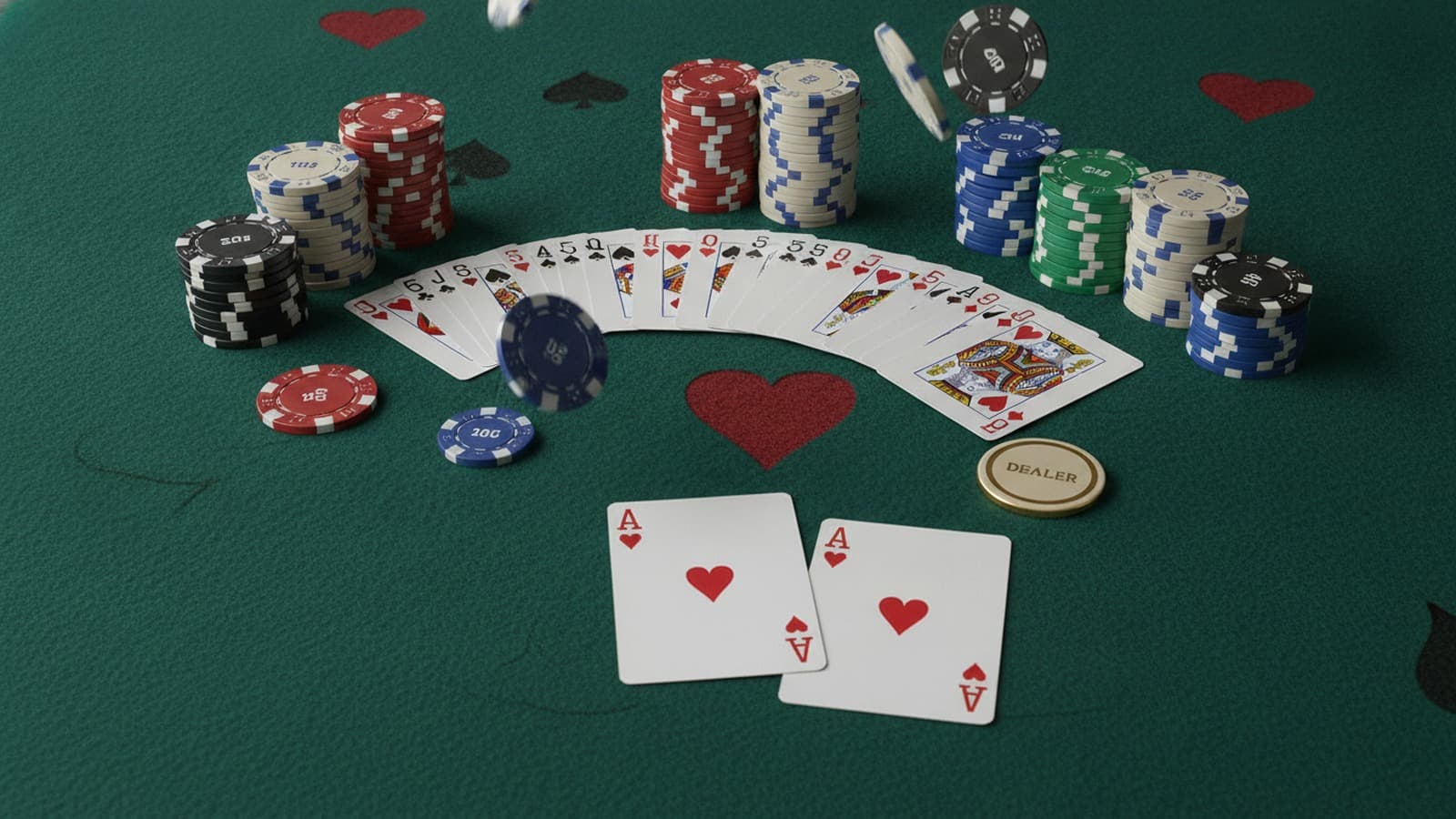
Poker rewards being ahead, not being certain. A pocket pair racing against a higher pocket pair before the flop wins the pot roughly 80% of the time and loses the other 20%, regardless of how correctly the money went in. That 20% is not a leak. It is the game working exactly as designed.
One Reddit thread makes the point better than any formula. A player on r/poker described running KK into AA seven times in roughly 15,000 hands on WPT Gold, and getting stacked every single time.
« This isn't an online poker is rigged post or anything, just a particular bad stretch of variance. »
u/PocketSevenss, r/poker
Seven king-versus-ace coolers in 15,000 hands is an unlucky stretch, not an impossible one. Across a career of several hundred thousand hands, results that extreme even out. Judged from inside a single 15,000-hand sample, they can look like proof the games are broken, or proof a strategy has stopped working, when in fact nothing about the underlying decisions has changed at all.
How can a correct decision still lose money?
Because correct decisions are graded on equity, not outcome. A hand played with 80% equity is the right play even in the 20% of cases where it loses, and a losing session built entirely on hands like that is not evidence of a leak. It is just the losing side of a favorable spot.
The maths: standard deviation and confidence intervals
Here is the actual calculation. For a 95% confidence interval, the margin of error around your true win rate is approximately 1.96 multiplied by your standard deviation, divided by the square root of your sample size in hundreds of hands. Assume a standard deviation of 80bb/100, a commonly cited estimate for a regular in six-max no-limit cash games, and the numbers look like this:
| Hands played | Margin of error (95% CI) | What it means |
|---|---|---|
| 1,000 | ± 50bb/100 | Your result could be anywhere from a huge winner to a huge loser |
| 10,000 | ± 16bb/100 | Still too wide to separate a small winner from a small loser |
| 50,000 | ± 7bb/100 | Useful for spotting a strong edge, not a modest one |
| 100,000 | ± 5bb/100 | A believable range starts to appear |
| 500,000 | ± 2.2bb/100 | Close to a stable, trustworthy win rate |
| 1,000,000 | ± 1.6bb/100 | The number you can start to defend with confidence |
SOURCE: own calculation, 95% confidence interval assuming an 80bb/100 standard deviation (a widely cited estimate for six-max NLHE regulars) · MAJ 09/2026
A 100,000-hand sample is roughly where a win rate stops being noise and starts being signal, and even then the margin sits around 5bb/100, wide enough to hide a real, meaningful leak.
What sample size is enough to compare two strategies?
Comparing two approaches (a tighter opening range against a looser one, for example) needs an even bigger sample than judging one strategy alone, because you are effectively measuring the difference between two noisy numbers. As a rough guide, expect to need several hundred thousand hands under each approach before a genuine gap in bb/100 separates from the noise.
How many hands is that in real playing time
Hand count only means something once you translate it into hours at the table, and the speed of the game changes that translation completely. According to BlackRain79, online cash games deal roughly 75 hands per hour at a 9-max table and around 90 hands per hour at 6-max, while fast-fold formats like Zoom or Snap run at 200 to 250 hands per hour. Live poker, by contrast, typically deals only 25 to 30 hands per hour.
Those numbers matter because they change the honest answer to "how long will this take?" At 90 hands per hour on a standard 6-max table, reaching 500,000 hands takes roughly 5,500 hours, or several years of serious volume for most recreational and semi-professional players. At 200 hands per hour on a fast-fold table, the same sample takes closer to 2,500 hours. A live player, dealt only 25 to 30 hands per hour, would need well over a decade of regular sessions to reach the same statistical footing an online grinder can reach in a couple of years.
The scale of the online game is what makes those hand counts realistic at all: global online gambling revenue, tracked annually by market researchers such as Statista, runs into the tens of billions of dollars, with poker forming a persistent slice of that volume. That is the backdrop against which "just play more hands" is actually achievable advice for a dedicated grinder, and just about impossible for anyone limited to a weekly live session.
Nobody is realistically going to play a million hands before making any decisions about their game. Waiting for statistical certainty is not a plan.
What you can actually learn from a small sample
None of this means a 500-hand or 2,000-hand session is useless. It means the session cannot answer "am I a winning player," and it should not be asked to. What it can answer is much narrower and much more useful: which specific decisions, in which specific spots, cost money regardless of the final result.
That is the difference between judging a win rate and judging a decision. A losing session is not a verdict on your overall game, and what a losing session actually tells you usually has more to do with two or three identifiable mistakes than with bad luck across the board. Reviewing rue by rue, rather than staring at the final tally, is how a leak gets found long before any win rate would ever confirm it exists.
A structured pass through a session, the kind described in how to review a poker session in 30 minutes and find your leaks, sidesteps the sample-size problem entirely. Instead of asking whether 3,000 hands prove anything about long-run profitability, it asks whether a specific c-bet, a specific fold, or a specific call was correct given the information available at the time. That question can be answered from a single session. Win rate cannot.
The honest takeaway is not that win rate is worthless. It is that win rate is a long-run number, and treating it as a short-run one is where players talk themselves into bad conclusions, in both directions. A downswing over 20,000 hands is not proof you got worse. An upswing over 20,000 hands is not proof you got better. Somewhere past a few hundred thousand hands, the number finally starts telling the truth, and until then, the decisions inside each session are the only thing worth grading.
FAQ
How many hands do I need for a reliable win rate?
There is no single cutoff, but the margin of error only becomes reasonably tight, around ±5bb/100, once you reach roughly 100,000 hands, assuming a standard deviation near 80bb/100. A genuinely stable number needs closer to 500,000 to 1,000,000 hands.
Why did I lose over a big sample even though I'm a winning player?
Because standard deviation in no-limit hold'em is large enough that even a real, positive win rate can show a losing result over tens of thousands of hands. A 20,000-hand downswing is well within normal variance for a player with a genuine edge.
Does a losing session mean I have a leak?
Not necessarily. A single session, or even several thousand hands, is far too small a sample to draw conclusions about your overall win rate. It can still reveal specific mistakes worth reviewing, which is a separate and more useful question than "am I winning overall."
Is standard deviation the same for tournaments and cash games?
No. Tournament results are generally far more variable than cash game results because of the top-heavy payout structure, so tournament players typically need an even larger sample of events, not just hands, before their long-run edge becomes visible in their results.
Can I speed this up by playing more tables at once?
Playing more tables increases hands per hour, which shortens the real-world time needed to reach a given sample, but it does not change how many hands are statistically required. The maths behind the confidence interval stays the same regardless of how fast you accumulate the hands.
Sources
- POKER ODDS: How many times do you hit each hand in Poker? — Zeros Poker
- Texas Hold'em Starting Hands, a beginner's guide — PokerStars Learn
- Poker basics for beginners
- Starting hands in Texas Hold'em, a beginner's guide — Alberto Russo
- How many times in your poker career have you ran KK into AA preflop? — r/poker
- How Many Hands Per Hour in Online Poker? Here's the Numbers — blackrain79.com